About this course
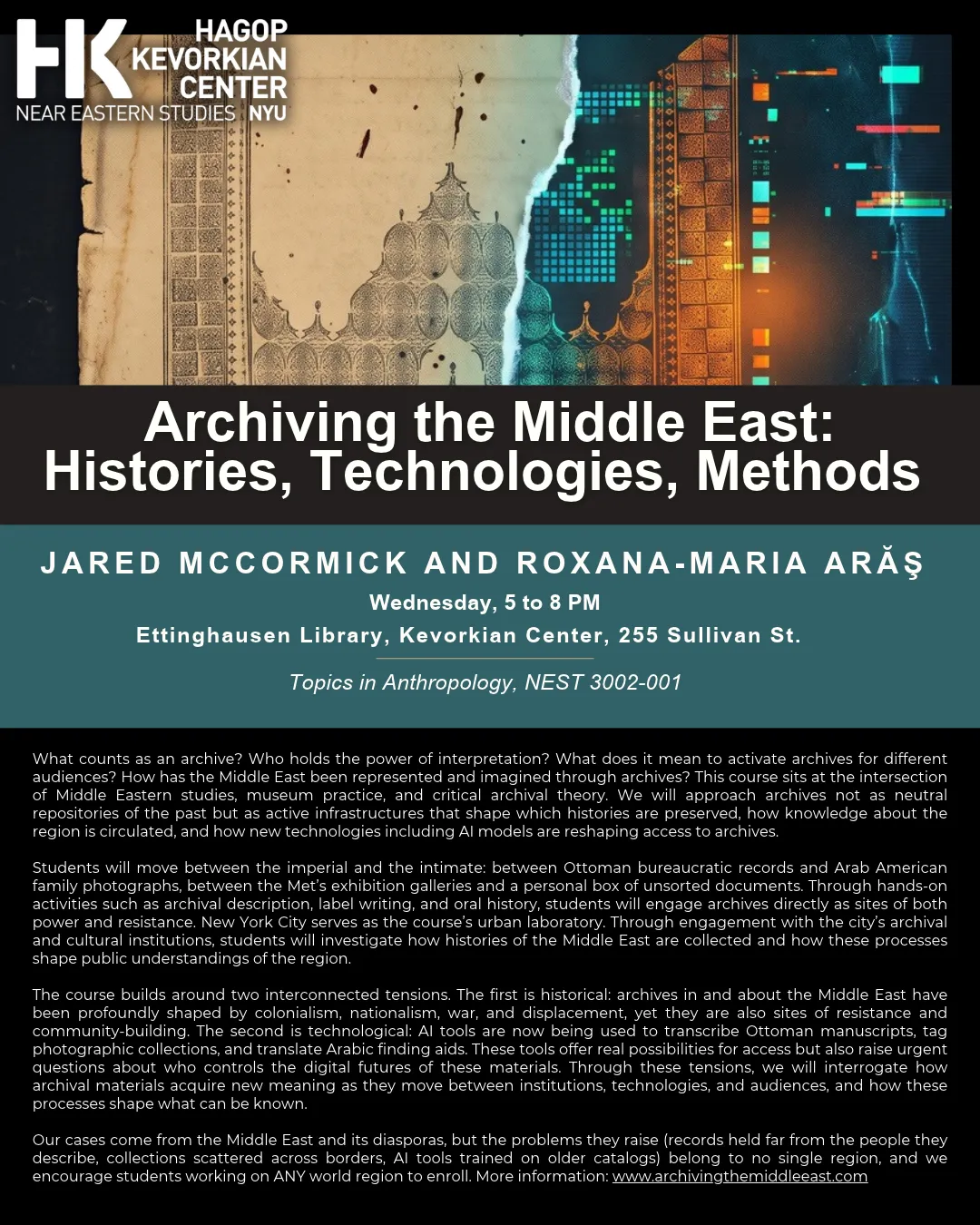
Why this course
Graduate training in Middle East studies needs more methods-based courses that bring theory, method, and hands-on research together rather than treating them as separate concerns. This course grows out of that conviction, and out of Archives in Dialogue, a webinar series built on the premise that you learn about archives by doing archival work, not only by reading about it. It also responds to the rise of AI and its effect on how we imagine access/conservation/knowledge production. There is a structural gap here in our approach to this course, namely, Middle Eastern Studies and Museum/Archival Studies have much to gain from each other.
Everyone does archives now
“The archive” has become one of the humanities’ most productive terms, and it is stretched. Scholars announced an archival turn, artists made archives, and three weeks in a reading room became archival work. The term now comfortably means anything old that somebody kept.
Anthropologists have watched this before. Ethnography was a method a discipline built over a century, with a theory of knowledge behind it and an ethics behind it. Now sometimes simply talking to people academics will call an “ethnography.” In a similar way the discipline of archival science, with its own journals, its own standards, and more than a century of theory, faces an appropriation of “archives” (for better and/or worse!). It has been arguing about precisely the questions the archival turn discovered, for longer, and with more at stake. Michelle Caswell has argued that the humanities’ failure to cite that field is not an oversight, archival studies was read as professional work rather than scholarship, and professional work does not get footnotes.
This course takes this second body of knowledge (the messy and real doing) as seriously as the first. Every session pairs concepts from archival practice with the regional case it illuminates, so students work with appraisal, provenance, custody and description on real material.
The tensions the course is organized around
The first is historical. Archives in and about the Middle East have been profoundly shaped by colonialism, nationalism, war, and displacement, and they are at the same time sites of recovery, resistance, and community-building. The same Ottoman register can document a state’s reach and, read against the grain, the lives it tried to count; the looting of the Iraq Museum and the burning of Mosul’s library show how quickly a record can be lost. Holding both readings at once lets us ask whose past an archive keeps, and for whom.
The second is technological. AI tools are now used to transcribe Ottoman manuscripts, or tag photographic collections. These tools offer real possibilities for access and inherit the biases of the collections they were trained on, which raises urgent questions about who controls the digital futures of these materials. A model that misreads an Arabic name or flattens a dialect writes that error into the catalogue the next researcher will search. Students test these tools on real material and weigh what they make visible against what they quietly distort.
The third is pedagogical. Students in this course are not all headed for academic careers, and even those who are will need to communicate beyond the university. Learning to translate archival knowledge across media and audiences is a skill that will differentiate them professionally. Over the semester students write labels, describe collections, and present their work.
Instructors
Faculty Fellow and Clinical Assistant Professor · Kevorkian Center for Near Eastern Studies, New York University
Roxana-Maria Arăș is a Faculty Fellow and Clinical Assistant Professor at the Hagop Kevorkian Center for Near Eastern Studies at NYU. She is an interdisciplinary scholar with a doctorate from the Interdepartmental Program in Anthropology and History at the University of Michigan, where she also earned a Certificate in Museum Studies, and her research sits where Eastern Christianity, sectarianism, and urban studies meet.
Her book project, drawn from the dissertation, examines Antiochian Orthodoxy in Lebanon through lived theology, sect, and crisis as an everyday condition rather than a rupture in ordinary life. The fieldwork follows how religious institutions absorb the work a failing state stops doing, and what that arrangement asks of the people on both sides of it. She contributed a chapter to Practicing Sectarianism: Archival and Ethnographic Interventions on Lebanon (Stanford, 2022), with articles in Comparative Studies of South Asia, Africa and the Middle East (2025) and the Journal of Eastern Christianity (Brill, 2024).
The museum training put her inside collections on both sides of the Atlantic, at the Arab Image Foundation in Beirut and the Arab American National Museum in Detroit, both of which this syllabus treats as case studies. She is also at work on a multimodal, open-access account of Lebanon’s 2019 uprising with Virginia Tech Publishing, which lands on the same ground as this course’s questions about what happens to archival material once it is translated for audiences outside the university. She has taught on everyday life in the Middle East, religion and violence, gender and religion, and the body in the region, arguing throughout for the community-engaged pedagogy on which this seminar’s final project depends.
Clinical Associate Professor · Kevorkian Center for Near Eastern Studies, New York University
Jared McCormick is Director of Graduate Studies and Clinical Associate Professor at the Hagop Kevorkian Center for Near Eastern Studies at NYU. He completed his PhD in Social Anthropology at Harvard with a secondary degree in Critical Media Practice, and he holds an MA from the American University of Beirut. Before joining NYU he taught at the University of Pittsburgh and at Virginia Commonwealth University in Qatar.
His larger research explores tourism and the imagination of place across the Middle East. The book manuscript drawn from his dissertation is a historical account of Lebanon’s tourism and leisure industry. A parallel project across the Arabian Gulf, in Qatar, Kuwait, the UAE and Bahrain, uses tourism as a way into state making, affective speculation, and a different reading of what infrastructure does.
The Critical Media Practice training is what shapes how he teaches method: visual and digital material belongs in the middle of a research process rather than appended to the end of one. He is co-founder of marra.tein, a residency space in Beirut for researchers and artists 2012-2019, and he is launching View from the View (forthcoming), an archive of thousands of Lebanese/Syrian postcards from 1890 to 1975 whose catalog is assembled with machine vision and language models.