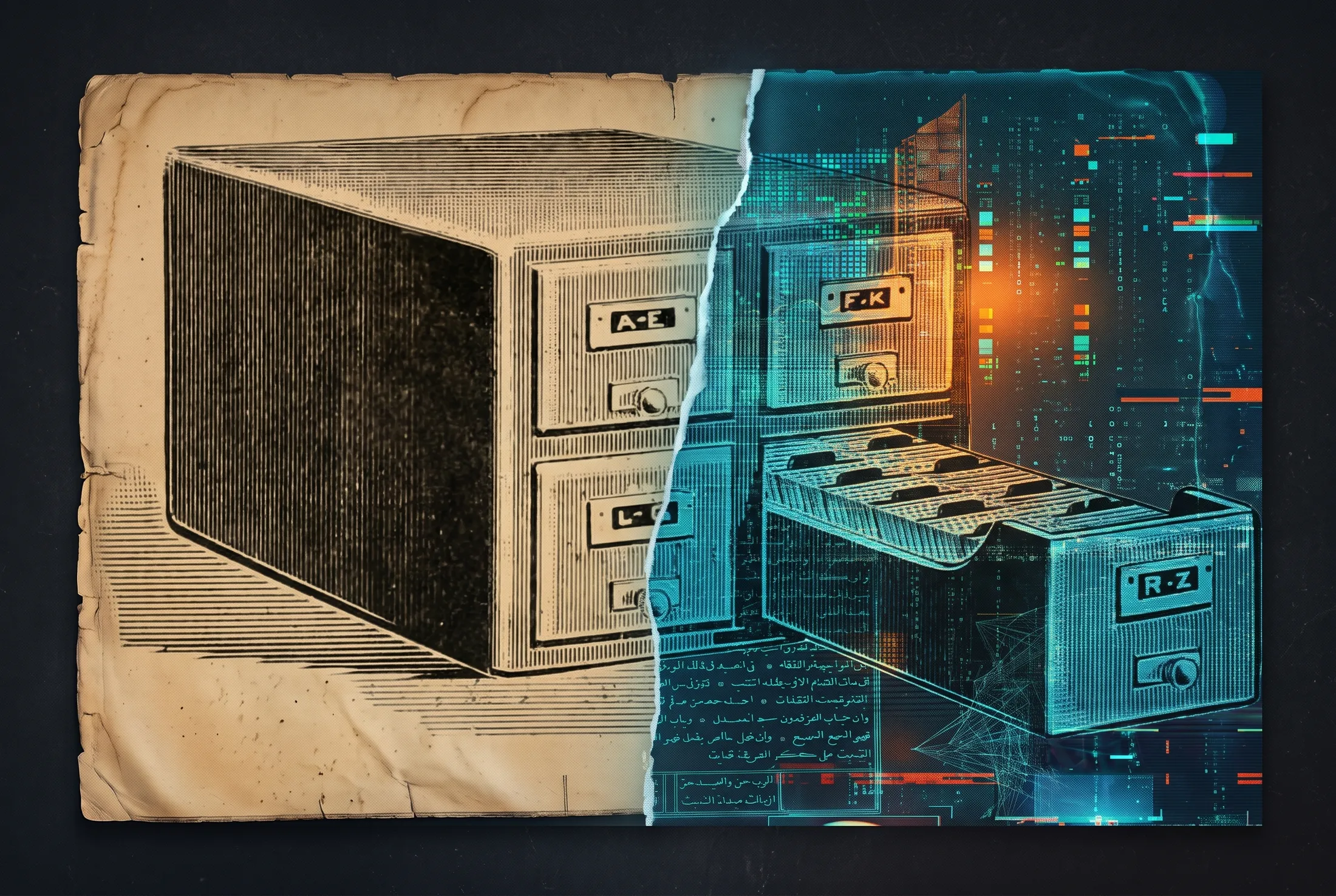
The 1898 engraving of a card catalogue cabinet, torn down the middle: on the left the cabinet in black ink on yellowed paper, its top drawer labelled A to E; on the right the same cabinet redrawn in glowing blue over columns of code and an orange light, its drawers labelled F to K and R to Z, the last pulled out to show the cards, above lines of Arabic-looking script that do not read as Arabic

Cluster IV · Sessions 10–12

AI, description, and the politics of metadata

Card catalog, from page 167 of Manual of Library Classification and Shelf Arrangement, 1898. Wikimedia Commons. · SourceGenerated with Google Gemini from this engraving, on the themes of the cluster. Its Arabic is the model’s own and unreadable.

The AI/digital thread moves to the foreground. What does it mean that the tools being used to make MENA archives more accessible were built on datasets that misrepresent the region, and who decides how they are used? This comes before the activation work so that students first grapple with what AI does and does not (cannot or should not) do.

10

Digital afterlives of colonial archives

AI cataloging tools are trained on existing catalogs, which means they inherit and amplify the biases already embedded in those catalogs.
Tools trained on existing catalogs produce descriptions that carry their distortions forward (at scale).

Our case is “View from the View,” an archive of Lebanese/Syrian postcards from 1890 to 1975, cataloged with machine vision and language models, Jared built the archive and pipeline.
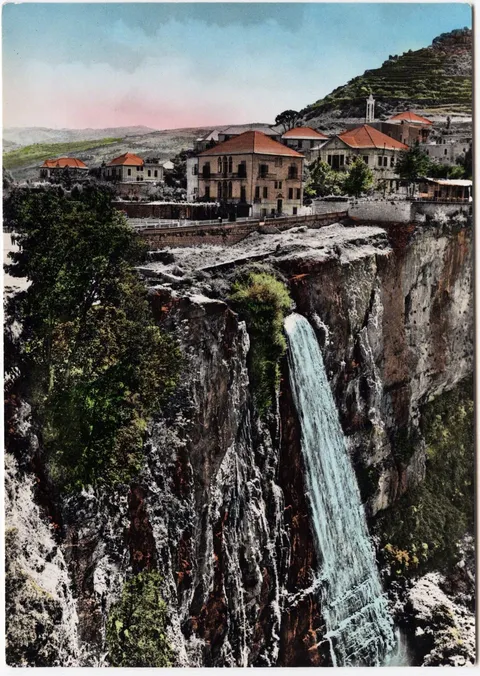
A hand-tinted postcard: a tall waterfall pours down a sheer rock cliff, and along the cliff’s edge above it stand stone houses with red tiled roofs, a bell tower and terraced hills under a pink and blue skyDjizzin Waterfall and Village, circa 1950–1965. View from the View. · Source
Hands-on Archive 2View from the View

Readings

  • Read

    Forthcoming

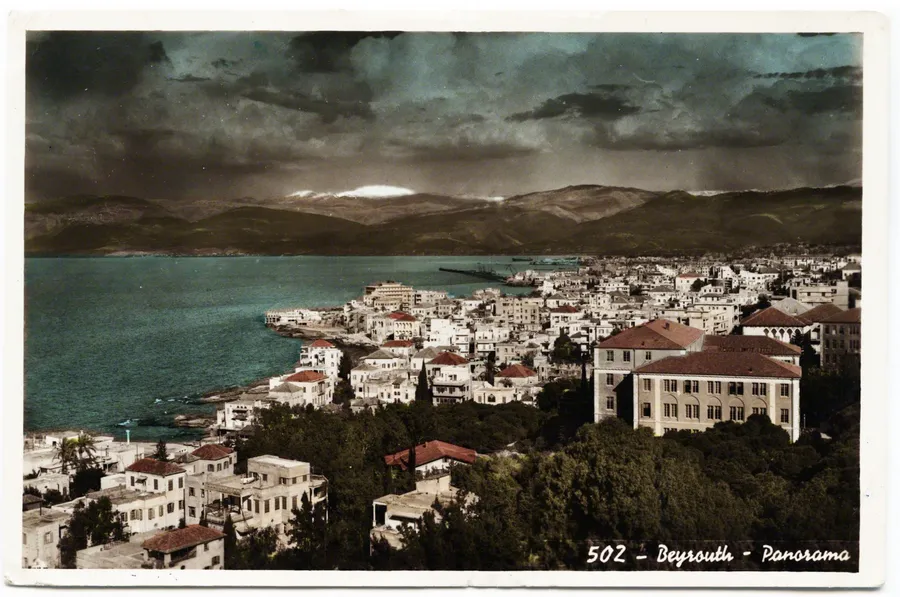
A hand-tinted real-photo postcard of the 1950s printed 502, Beyrouth, Panorama: tiled and flat roofs among dark trees in the foreground, a large building with a red tiled roof at the right, the blue bay and the harbour beyond, and snow on the mountains under a heavy sky
Beirut Panorama from Elevated Vantage, circa 1950–1960. View from the View. · Source
11

Digitization, access, and new gatekeepers

Ambitious projects digitizing Arabic-language materials using custom AI models. What gets prioritized for digitization, and why?

Does digital access democratize collections, or simply create new gatekeepers with different profiles?

Session 10 looks at the postcards; this session looks at the machinery behind them. A confidence threshold is an appraisal decision: someone picked a number, and that number decides which records a scholar will ever see. Recording provenance for each single metadata claim applies the discipline’s oldest principle to data.

When a schema is the gatekeeper, who does a researcher object to?

Readings

  • Read

    Forthcoming

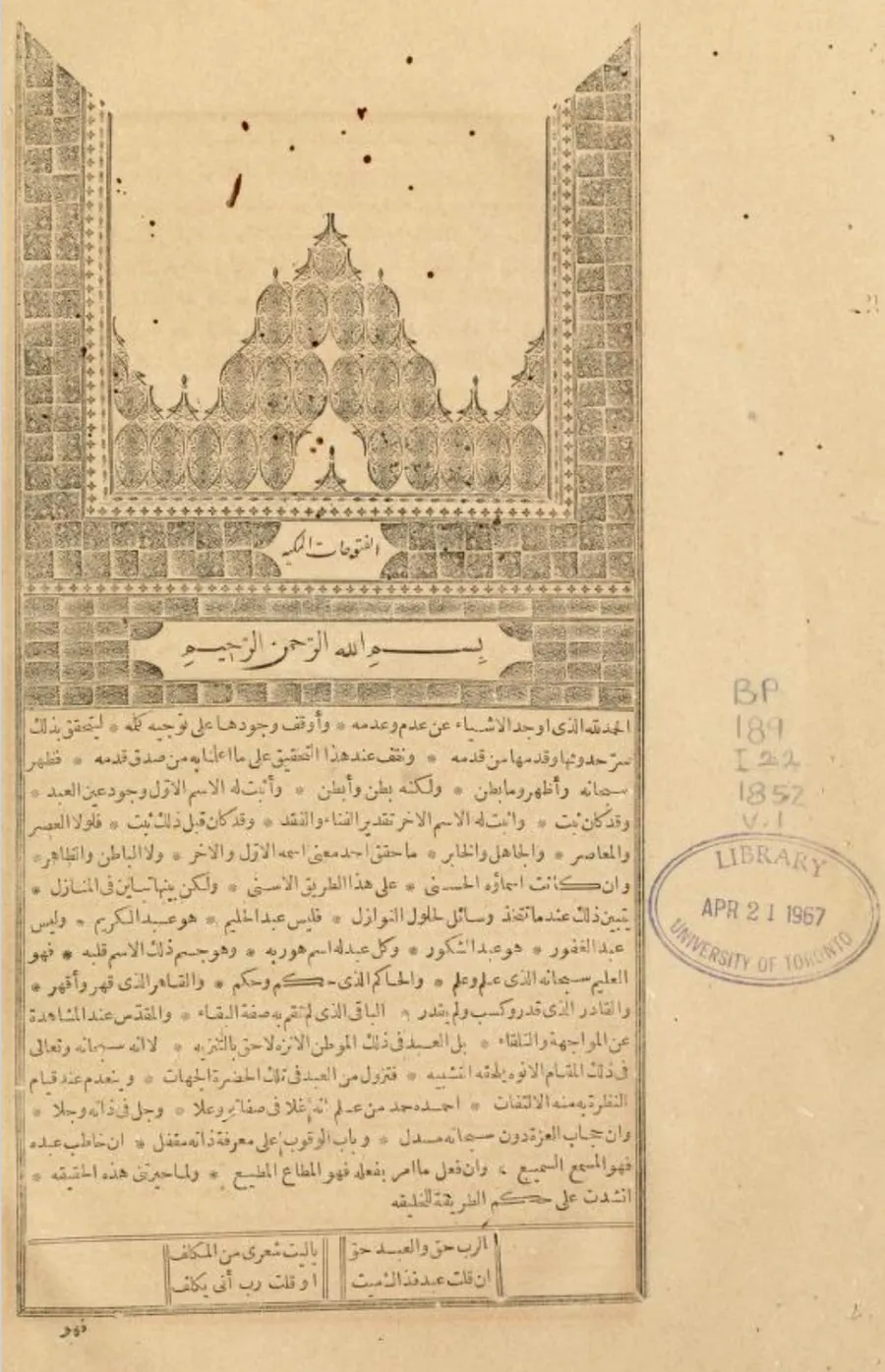
The opening page of the first printed edition of Ibn Arabi’s Meccan Revelations, Bulaq, 1269 (1853): a printed ornamental headpiece in a patterned frame over the title and the basmala, then lines of Arabic text, with a University of Toronto library stamp of 1967 and a call number in the margin
Meccan Revelations, Bulaq Press, first edition, 1269 (1853). Wikimedia Commons. · Source
12

“Fake” archives and ethical stakes

What happens when AI can produce plausible archival materials that never existed?

In a region where authentic records have been systematically destroyed and where fabricated evidence has real political stakes, the problem is a practical one. The session ends by returning to the question that opened the course: who decides what is kept, cataloged, translated, and made legible, and on whose authority?
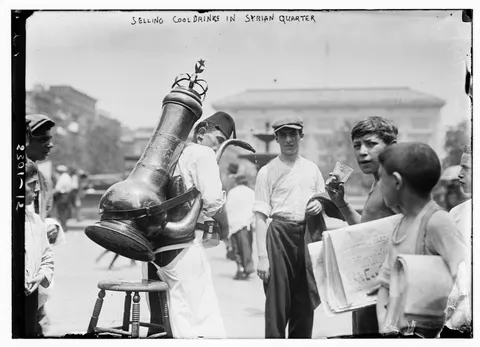
A street vendor with a tall ornate brass urn strapped to his back serves a drink to a group of boys, one of them holding newspapers; the negative is captioned by hand, Selling cool drinks in Syrian QuarterSelling cool drinks in Syrian Quarter (NYC), about 1910. Bain News Service; Library of Congress. Public domain. · Source
Field Trip 3A walking tour in Little Syria

Readings

  • Read

    Forthcoming

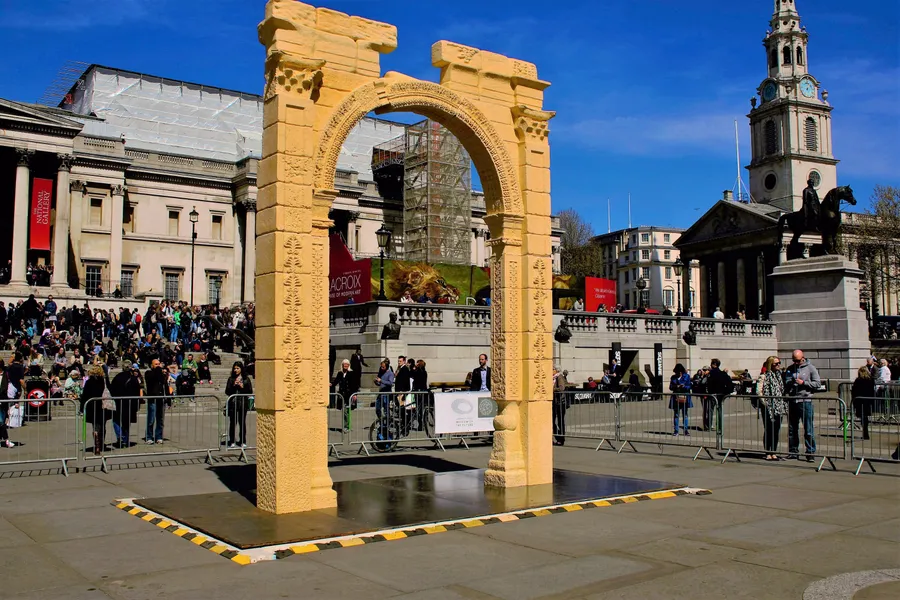
A full-size replica of a Roman arch in sand-coloured stone on a dark plinth in Trafalgar Square, crowds behind barriers around it, the National Gallery’s portico at the left and the spire of St Martin-in-the-Fields beyond
Replica of Palmyra’s Arch of Triumph, Trafalgar Square, 20 April 2016. Wikimedia Commons; photo Soulfingerclivey, CC BY-SA 4.0. · Source